H.H. Dorje Chang Buddha III’s Accomplishments in Decorative Wall Hangings
Decorative wall hangings refer to works of art hung on a wall. Included among them are figures of animals and people; carvings of ivory, copper, jade, wood, or stone; embroidery; lapis lazuli inlays; artwork relating to flowers, vegetation, tree branches, or feathers; porcelain objects, etc.
In order to fill the inadequacies of modern day wall hangings, H.H. Dorje Chang Buddha III Wan Ko Yeshe Norbu Holiest Tathagata applied His Buddha powers to create with great facility decorative wall hangings in a myriad of artistic styles that express outstanding novel concepts. These numerous genres are quite diverse, highly elegant, and pleasing to the mind and eye.
We have included six of his decorative wall hangings in this book. One contains the Chinese character fu, which means good fortune or blessings. Here it means beseeching H.H. Dorje Chang Buddha III to bring good fortune or blessings to living beings. Another contains the English word peace. We hope that the entire world will become peaceful and prosperous. The decorative wall hanging called “Fu” was sculpted out of a faux white jade plate with the Chinese character resembling natural tree vines. The English word in the decorative wall hanging called “Peace” was made from faux deep-sea coral. The periphery of that work of art has the natural winding look of ancient tree vines. This marvelous work is a joy to behold.
The decorative wall hanging called “Mani Treasure” expresses the wisdom-power of the Three Secrets; namely, the body, speech, and mind of the Buddha. Another work of art entitled “Old Gourds With Withered Vines” displays a highly charming style that is rustic, simple, unadorned, elegant, and beautifully aged. The decorative wall hanging “Jia” (“Home”) represents warm feelings. In that work, the purity and elegance of faux green jade was used to symbolize a vibrant and harmonious family. The artwork entitled “The Bone of the Earth and Ganoderma” shows ancient fossils of ganoderma lucidum that look thousands of years old. This decorative wall hanging, which symbolizes world peace, has the appearance of a cultural relic that embodies the core of Chinese and western culture.
(This text was translated from the Chinese text that follows.)
H.H. Dorje Chang Buddha III’s Accomplishments in Buildings and Decorative Landscape Design
H.H. Dorje Chang Buddha III Wan Ko Yeshe Norbu Holiest Tathagata has reached great heights in the design of temples, towers, pavilions, arbors, structures in the style of the Ming and Qing Dynasties, modern western houses, and decorative landscape scenes. Because of limited space, we have selected only a few of examples of structures and decorative landscape scenes designed by H.H. Dorje Chang Buddha III.
(This text was translated from the Chinese text that follows.)
The decoration in the middle of the garden is a faux white jade sculpture called “Melody in Motion.” It seems to change constantly when viewed from different angles. 庭園中央裝飾的羊脂玉雕塑「動的旋律」,八面觀看變化無窮A “country villa” designed for a dog為狗設計的鄉土別墅Part of a house garden that was designed by H.H. Dorje Chang Buddha III. 三世多杰羌佛設計的房屋庭園一角Buildings and decorative landscape scenes designed by H.H. Dorje Chang Buddha III.三世多杰羌佛的建築及庭園設計Golden Garden Path金色庭園路Hollywood Movie Scene好萊塢電影取景場
H.H. Dorje Chang Buddha III’s Accomplishments in Tea- Bi Yu Chun & Ba Wang Chun
The tea Bi Yu Chun was rated the highest-grade tea in China. That tea is one of the products of H.H. Dorje Chang Buddha III Wan Ko Yeshe Norbu Holiest Tathagata that is based on His Holiness’s wisdom and mastery of the Five Vidyas. H.H. Dorje Chang Buddha III has developed the ancient, traditional techniques of producing tea to a level of perfection, resulting in the creation of this superior quality green tea.
When discussing the creation of teas by His Holiness, we should first mention what happened when two people formally became disciples of H.H. Dorje Chang Buddha III. Two people who operated a tea factory came to H.H. Dorje Chang Buddha III to formally recognize His Holiness as their Master. H.H. Dorje Chang Buddha III asked them what they wanted to learn. They said, “Of course, we have come here to learn the Buddha-dharma. We operate a tea factory, but we cannot learn the craft of making teas here.” H.H. Dorje Chang Buddha III replied, “There is everything here. I will first teach you how to make tea.” Within three days, H.H. Dorje Chang Buddha III invented the world’s highest grade tea. His Holiness taught those two disciples how to make that tea. However, everyone should understand that H.H. Dorje Chang Buddha III had never made any teas prior to that time. There is nothing that a Buddha cannot do. Precisely because of this, His Holiness was able to create with ease a top-grade world-famous tea.
The tea Bi Yu Chun has a unique flavor and a refined quality. The tealeaves are compact and delicate, retain their original fuzz, and have the color and luster of green jade. This tea has the pure aroma of chicken broth or roasted chestnuts. It is pleasantly refreshing and maintains its rich flavor for a long time. The tea is translucent, showing a lustrous green like that of green jade and can be compared to a mountain spring. Long after you taste it, you will ponder its delightful flavor.
A competition to select the best Chinese teas took place in June of 1989. Bi Yu Chun and Chinese teas such as Shi Feng Long Jing, Dong Ting Bi Luo Chun, and Jun Shan Yin Zhen were all under consideration in the selection process. In accordance with the conventional rules of evaluating teas, an evaluation committee composed of tea experts evaluated the “eight main factors” and the “two main characteristics relating to appearance.” Bi Yu Chun received 101 points, which is beyond all grades, making it the top Chinese tea. The experts acclaimed Bi Yu Chun for remedying the three shortcomings of Chinese green tea: not being green enough; having a bitter, astringent taste; and inability to withstand the steeping process well. Based on this alone, Bi Yu Chun has surpassed the highest world standards in the production of tea. Thus, Bi Yu Chun is praised as being the foremost of all Chinese teas.
On August 23, 1989, an evaluation meeting was convened in Beijing to evaluate Bi Yu Chun. Chinese tea experts and famous people from all walks of life participated in that meeting. That evaluation resulted in Bi Yu Chun being extolled as a rare treasure in the world. More than seventy news media reported this. The Beijing news channel broadcast that meeting live. The central television station reported the Bi Yu Chun evaluation meeting as a news item and stated that Bi Yu Chun is the premier tea. Bi Yu Chun thereby shocked the entire country of China, and it became famous abroad as well. It was selected as the representative tea of China at the International Tea Culture Exchange Convention held in Japan. The evaluation committees of the sixty-sixth and sixty-seventh International Trading Conventions categorized Bi Yu Chun as a tea that should be offered to honored guests.
Not long after that, H.H. Dorje Chang Buddha III casually dipped into His limitless wisdom to develop a type oolong tea called Ba Wang Chun. It is a half-fermented tea with a unique flavor. It combines the fragrances of tea, coffee, and chestnuts. Its taste has the positive qualities of tea and coffee. It is rich yet simple, with a delightful fragrance. Drinking this tea can bring about loss of weight with no loss of energy. It has a refreshing, mind-clearing effect. Tea experts have acclaimed it as being the king of oolong teas, and it has become famous around the world!
H.H. Dorje Chang Buddha III was not attached to the huge successes of both Bi Yu Chun and Ba Wang Chun. For no compensation whatsoever, His Holiness disclosed the secret production technology to those two lay disciples, both of whom worked at the Chengdu Changcheng Health Care Products Factory. His Holiness also prohibited them from revealing that His Holiness was the one who disclosed such tea technology to them. What is even more laudable is that H.H. Dorje Chang Buddha III did not want one cent of the profits. His Holiness’s only request was that they use part of the profits to take care of elderly people who live alone and children who are deprived of an education due to financial difficulties. Having no other choice, those two disciples used the name Dharma Master Shi Xing as the inventor of those products to show their appreciation for the teachings of H.H. Dorje Chang Buddha III and Sakyamuni Buddha.
How many people in this world truly do not care about fame and gain? Can a person like H.H. Dorje Chang Buddha III be found anywhere in the world? It would be good if even one person like His Holiness could be found. However, such a person cannot be found. Words are inadequate to describe the holy virtue and magnificence of H.H. Dorje Chang Buddha III. How could even a great Bodhisattva possess the limitless omniscience that His Holiness possesses? Such real life examples of indifference to fame and gain enable us to see the enlightenment of a true Buddha!
(This text was translated from the Chinese text that follows.)
(Left) Bi Yu Chun is known as the foremost of Chinese famous teas. (左邊)被譽為中國名茶之首的碧玉春; (Right) Tea experts praised Ba Wang Chun as the best of all Oolong teas. (右邊)被茶界專家譽為烏龍之首的「霸王春」
CHENGDU CHANGCHENG HEALTH CARE PRODUCTS COMPANY XINFAN BRANCH Certificate
Our company is a famous professional health care product company. “Xiongli Yufayi” (formerly called Fa Bi Sheng), the frostbite liquid “Yici Ling” (also known as Xiongli Fang Dong Yi), the green tea “Bi Yu Chun,” and the Wulong tea “Ba Wang Chun” are produced by our company.
“Xiongli Yufayi” is a health care product that helps hair regrow. It was the first hair growing product ever examined and approved by the Chinese Health Ministry. It was approved in 1989.
The frostbite liquid “Yici Ling” is a powerful medicine that can cure and prevent frostbite. It has relieved many patients’ pain.
The green tea “Bi Yu Chun” is the highest quality tea among Chinese famous teas. It won the unprecedented score of one hundred and one points at the Chinese Famous Tea Contest. It not only was designated as the tea for honored guests at the 67th International Trading Convention, but also was selected as the representative tea of China at the International Tea Culture Exchange Conference sponsored by Japan.
“Ba Wang Chun” is the type of Oolong tea that is semi-fermented. It has a unique taste. The tea is strong and rich. It is praised as the king of Oolong teas.
The above products were invented and developed by Master Wan Ko Yee (H.H. Dorje Chang Buddha III). However, he does not have the desire to obtain fame and wealth from them. Without expecting any reward, he handed over to us the right to manufacture these products, which are beneficial to mankind. For more than ten years, the Master has not received any share of the profits from those products, nor has he allowed us to publicize that he has invented and contributed the products. His only request is to devote a share of the profits to support old people in aged care facilities and needy children who cannot get an education due to poverty. Therefore, we asked the Master, “How are we going to introduce the inventor of those products?” The Master replied, “I am a Buddhist. These products belong to Buddhism.” Since the Master did not agree to use his name, we have considered this matter for a long time. We understand that Buddhism was established by Sakyamuni Buddha and to become enlightened and realize our original nature is the goal for all Buddhists. Thus, we decided to use “Dharma Master Shi Xing” as the inventor of the products.
Today, we disclose the secret to make everyone understand that the Master is selfless, always cares for others, and silently contributes to mankind. This kind of noble morality is a role model for us to emulate. The Master is our supreme holy teacher!
(Seal) Chengdu Changcheng Health Care Products Company Xinfan Branch
Examining Claims About Namo Dorje Chang Buddha III and Recognition Documents
Since the publication ofH.H. Dorje Chang Buddha III- A Treasury of True Buddha-Dharma, various allegations have circulated online, including claims that Namo Dorje Chang Buddha III declared Himself to be a Buddha or fabricated recognition documents. Before accepting such accusations, it is important to examine whether they are logically consistent.
Consider a simple example. Suppose a person knowingly possessed a forged recognition document falsely attributed to a respected religious leader. Would that person deliberately publish the document in a book distributed around the world?
From a practical standpoint, such an action would make little sense. Publishing an allegedly forged document would immediately invite scrutiny from the very individual or institution whose name appeared on it. If the document were indeed fabricated, a public denial could be issued promptly, destroying the publisher’s credibility and potentially leading to legal consequences.
For this reason, the allegation does not appear logically consistent. Deliberately placing an allegedly forged document before the entire world would be one of the quickest ways to expose a fraud if fraud had actually occurred.
The same reasoning applies to the recognitions published in the book. By making these materials publicly available, they became open to examination by religious leaders, scholars, journalists, and readers alike. Rather than remaining hidden, they were presented openly for public scrutiny.
Therefore, from the standpoint of reason and sound logic, the accusations that Namo Dorje Chang Buddha III simply claimed to be a Buddha or forged fake documents to portray Himself as a Buddha are not only unfounded but also absurd and entirely lacking in credibility. Readers should examine the recognitions, historical records, and related documents themselves instead of relying solely on brief descriptions or repeated online assertions.
Serious conclusions deserve careful investigation. Repetition of an allegation does not, by itself, establish its truth. Before accepting or rejecting any claim, it is more reasonable to examine the original sources, consider all available evidence, and arrive at an informed conclusion based on facts rather than assumptions.
My First Experience at the Dharma Assembly Honoring the Holy Birthday of Namo Dorje Chang Buddha III
My First Experience at the Dharma Assembly Honoring the Holy Birthday of Namo Dorje Chang Buddha III
Before attending the Dharma Assembly Honoring the Holy Birthday of Namo Dorje Chang Buddha III, I knew very little about Buddhism and had never participated in such a large-scale Buddhist event. I accepted an invitation out of curiosity, expecting to observe a traditional religious ceremony. What I experienced, however, far exceeded my expectations and left a lasting impression on me.
Glendale Civic Auditorium
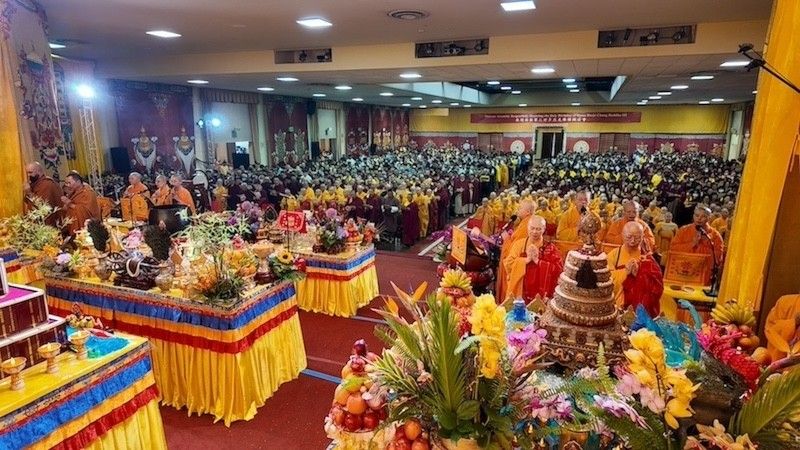
From the moment I entered the venue, I sensed an atmosphere of dignity, serenity, and profound respect. The beautifully arranged altar, the graceful floral decorations, and the orderly seating reflected meticulous preparation. Despite the large number of attendees, everything proceeded with remarkable precision and harmony. Volunteers guided participants with genuine warmth and courtesy, always wearing welcoming smiles and patiently assisting anyone who needed help.
What amazed me most was the extraordinary level of organization. Every part of the Dharma Assembly unfolded smoothly and reverently. There was no confusion or disorder, even though people from many countries and cultural backgrounds had gathered together. The entire event demonstrated an impressive spirit of cooperation, discipline, and mutual respect that is rarely seen at gatherings of this size.
Below, I would like to share several news videos covering this event. I believe they beautifully demonstrate how well-organized, dignified, and solemn the ceremony appeared to the public. I was genuinely amazed and deeply impressed by how beautifully the entire event was conducted.
As I observed the ceremony, I was touched by the sincerity of everyone present. The participants were not merely attending an event—they were expressing heartfelt reverence and offering prayers for world peace, the well-being of humanity, and the happiness of all living beings. It was inspiring to witness so many people united by compassion and goodwill rather than personal interests.
Although I am not a disciple of Namo Dorje Chang Buddha III, attending this Dharma Assembly gave me an opportunity to learn more about Him and the values that His teachings encourage. As I listened to those around me speak about His teachings and observed the compassion, humility, and kindness reflected throughout the event, I began to understand why so many people deeply respect and appreciate Him. The atmosphere itself conveyed a powerful message—that genuine spiritual practice should inspire people to become more compassionate, more considerate of others, and more dedicated to creating harmony in society.
One aspect that particularly moved me was the selfless dedication of the volunteers. They worked quietly behind the scenes without seeking recognition, ensuring that every participant felt welcomed and cared for. Their humility, patience, and willingness to serve others demonstrated values that many people, regardless of their religious beliefs, would admire and respect.
As the Dharma Assembly came to a close, I found myself reflecting on the experience. In today’s fast-paced world, opportunities to witness such sincerity, harmony, and mutual respect are increasingly rare. This gathering was much more than a ceremonial celebration; it was a powerful reminder that kindness, compassion, and selfless service have the ability to bring people together across cultures and backgrounds.
I left the venue with a heart full of admiration and gratitude. Although I came simply as a visitor, I departed with a much deeper appreciation for the positive influence that Namo Dorje Chang Buddha III has had on so many people’s lives. Seeing thousands of individuals inspired to cultivate kindness, serve others, and pray for the well-being of the world was deeply moving.
I am grateful for the opportunity to have attended this remarkable Dharma Assembly. It was an unforgettable experience that broadened my understanding of Buddhism and demonstrated how genuine compassion and harmony can unite people from all walks of life. The solemnity of the ceremony, the exceptional organization, and the sincere spirit of everyone present will remain in my memory for years to come.